Wednesday, 22 May 2019

It takes a village

Through the contact form on our blog, we recently received an email with the following question: “How do you organize yourselves so that the complex work of settlement and support can happen for multiple families without burning out your team of volunteers?”

It's an important question, and not an easy one to answer. Each of the three families that we have sponsored so far arrived after the first year of settlement of the previous family was over, so that made things easier. But having enough volunteers to carry out all the tasks needed is no easy feat, especially for the latest arrival, a single mum with four children, who needs a lot more support than the previous families.

Being a group made up entirely of volunteers can be a challenge. It means that people are not always available, and not always reliable. Everyone has busy lives outside the Ripple group – work and family obligations, holiday trips and so on. A number of people who joined the group four years ago have since dropped out, while others who are nominally members only sporadically chip in. Community sponsorship groups such as ours are vulnerable to this kind of fluctuation and unpredictability – unlike churches, for example, which can pull in volunteers from a wider congregation.

Newcomer and group members' kids mingle at an Easter party
We have learned a number of lessons of how to make it work, despite all the challenges.
  • For the latest settlement, we actively recruited new volunteers who have daytime availability (since many of the ‘old’ members have full-time jobs). All of them are absolutely amazing, always ready to step in when help is needed. We even found a wonderful volunteer ESL teacher who is teaching the mum at home, since she cannot attend formal classes due to a lack of access to childcare.
  • Being a volunteer in our group is ideal for people who want to be flexible and who have only a limited amount of time. Except for the English lessons, the need for support varies from week to week and people can volunteer whenever it fits into their schedule. 
  • Several of our new volunteers live close to the family’s home, which makes volunteering easier, especially if support is needed at short notice. 
  • Online tools are our friend when it comes to organizing ourselves – especially a shared google calendar and a messenger group where we post updates and ask for support, as well as google docs to share information. 
  • We have had the same chair and several key members since the beginning, which allows for continuity. 
  • Regular meetings with all volunteers, as well as regular message exchanges, help keep up a sense of community and being 'on the same page'.
  • Last but not least: We all agree that supporting this beautiful famil is extremely rewarding! We genuinely enjoy hanging out with them and probably get as much out of the experience as the family does. 


                                                                                                                         By Claudia Blume


Wednesday, 3 April 2019

The Ripple Effect

A living room meeting leads to a BVOR sponsorship group 


Yosief Araya, Director of the Refugee Sponsorship Training Program (RSTP), remembers the first time he heard from what later became the Ripple Refugee Program, a Toronto group that has since sponsored 17 individuals, including two BVOR families. 


“I got a call from Andrew Fitzgerald inviting me to speak about refugee sponsorship to some of his friends and neighbours,” Yosief says. He has spoken about refugee sponsorship to groups across Canada, but “it was the first time I’ve ever been invited to speak in someone’s living room.” That was early in 2015, before the Canadian government committed to bringing 25,000 Syrian refugees to Canada. 

Andrew’s motivation was straightforward, “These are global problems. I can do something to relieve the sense of despair I have … I can help at least one family.” Aware that the group’s help might be “just a drop in the ocean,” members focus instead on the ripple effect of that drop, hence their name. The Ripple Refugee Project helps others learn from its sponsorship experience through a blog, which includes everything from articles on the sponsorship experience to recipes and reflections from the newcomers
Members frequently speak with the media to raise the public’s awareness of the continuing need for refugee sponsors. Ripple Refugee Project’s first BVOR family of eight arrived in late 2015. In December 2018 their second BVOR case arrived, a young Eritrean family of five led by a single mother. Members of this family became social media stars when a video of the children enjoying snow for the first time went viral. UNHCR profiled the family and Ripple Refugee Project’s sponsorship activities in a video.(see video) Ripple Refugee Project now focuses on sponsoring BVOR cases with the help of its partner, Rosedale United Church. As frequent sponsors, they appreciate the faster arrival times and lower costs of BVOR sponsorship. 

If you know a group of people considering refugee sponsorship through the BVOR program, RSTP will be happy to talk with them. Please e-mail them at bvor@rstp.ca.

Yosief Araya's article was first published in the RTSP's BVOR newsletter (February 2019)

Wednesday, 13 February 2019

Refugees in need of sponsors

Two of the three families we helped settle in Canada, including the Eritrean family of five who arrived in November 2018, have come here through the BVOR program.

The program is designed to resettle refugees identified by the UNHCR that have been referred to Immigration, Refugees and Citizenship Canada (IRCC).The BVOR program is a “blended” program because it is a cost-sharing arrangement whereby the Canadian government and private sponsors contribute financially to support the refugees. Private sponsors are also responsible for providing settlement support to the refugees for 12 months.

Our group decided for a number of reasons to focus on BVOR-refugees rather than on named-case sponsorships. Although bringing in refugees through this program is fast, and doesn't require to raise a lot of money, there appears to be a shortage of community sponsorship groups who are putting up their hands for BVOR refugees.

The Canada office of the UNHCR produced a video, featuring the Ripple Refugee group, to encourage other Canadians to welcome refugees through this unique program. If we can do it, so can you!

Tuesday, 1 January 2019

New Year's Visit from Minister Hussen

It was a New Year’s Day that our Eritrean newcomer family and we, their sponsors, will not soon forget. January 1, 2019 began with a visit of very special guests: Ahmed Hussen, Canada’s Minister of Immigration, Refugees and Citizenship and Mohamad Fakih, Lebanese-Canadian entrepreneur and philanthropist.


Minister Hussen first reached out to us after seeing the adorable video of the two eldest children of the family enjoying their first snowfall in Canada that our group member Rebecca had posted on social media in November. The video went completely viral within hours, was picked up by media around the world and even retweeted by Canadian Prime Minister Justin Trudeau.

Minister Hussen (right) and Mohamad Fakih interact with the family
The Minister’s visit to the family’s new apartment coincided with the birthdays of mum Jamila and her two eldest children, who turned eight and six. January 1 is a birthday they share with many newcomers to Canada who used to be refugees. Many people who flee their homes and don’t have birth certificates get assigned this date of birth when they register as refugees, and carry it over when they fill out forms in their new home country.

Minister Hussen not only brought lots of gifts for the family and helped us sing Happy Birthday, he also discussed the benefits of Canada’s private sponsorship model.  Together with the UNHCR and other partners, the government launched the Global Refugee Sponsorship Initiative two years ago and has successfully promoted the community-based sponsorship model to a number of countries around the world, such as the UK, Germany and New Zealand. The minister said that we need to normalize the support for refugees. He urged all Canadians to amplify positive stories about immigrants and the enormous benefits Canada is reaping because of the contributions of the many newcomers who are coming here each year.

A case in point were our two visitors. Minister Hussen arrived in Canada as a teenage refugee from Somalia. Mohamad Fakih founded Paramount Fine Foods, a chain that now has 80 restaurants around North America and has more than 150 Syrian refugees among its employees, only a few years after arriving almost penniless from Lebanon. He is now partnering with the UNHCR and is talking to other businesses in Canada about hiring and sponsoring refugees.

It seems hard to believe that less than two months ago, Jamila and her four small children were living in a refugee camp in Sudan, unsure about their future. She did not know that a sponsorship group was waiting for her at the airport in Toronto and expected in fact to be settled in yet another refugee camp (the information sharing with privately sponsored refugees prior to their arrival is something that definitely needs to improve!). 


Today, the family experienced the kind-heartedness and openness not just of ordinary Canadian citizens but even a high-level government official. It is hard to think of a better way to start a new year, and indeed, a new life.


By Claudia Blume

Sunday, 9 September 2018

Please help us bring an Eritrean family of five to Canada

We need your help! The Ripple Refugee group is sponsoring a young mother and her four children, all under 8 years old. The family was forced to flee their home in Eritrea and is currently residing under precarious circumstances in neighboring Sudan. Eritrea is recognized as having one of the most repressive regimes in the world. 


The UNHCR and the Canadian Government have reviewed and approved the family’s application for refugee status and they could arrive in Toronto before this coming Christmas. Our group has chosen to support this young mum and her small children because they are very vulnerable and because we think we can make a huge impact on their lives.

But we need to raise $25,000 to make this happen. Any donations over and above this amount will be used for refugee sponsorships our group will undertake in 2019.

Tax-receipted donations can be made on-line via the Rosedale United Church’s (our sponsorship agreement holder) donation page at Canada Helps (please click here). Please be sure to indicate in the box marked “Include a message for this charity” that the donation is for: RUC-25 Ripple Refugee Project.


Eritreans seeking safe passage to Sudan (credit: UNHCR)
Because of the generous support of our donors we have been able to sponsor and settle two Syrian families and one individual over the last three years, totalling twelve people. You can read about their incredible stories and the journey that our group of concerned citizens from Toronto has been on in our blog.

For more information about donating to our group, please click here

Thursday, 23 August 2018

Arrivals

I travel a lot for work. When the flight home is over, and after the final exhaustion of body and soul by customs lines and luggage carousels, I used to race through the automatic doors to the international arrivals hall and grab a cab or Uber for the last twenty-one kilometres of the trip.


But for the past two years, though still always heart-hungry to get home quickly and see my family, I now stop and look around when I’m through those doors and free to leave.

I look for signs. Literally. “Welcome xxx Family to Canada!” they say, and, usually "مرحبا بكم في كندا." Sometimes "bienvenue au Canada”. If you know the acronyms and lingo, no small talk with the signs’ bearers is needed. GAR, JAS, or BVOR*? Have you already spoken with the family? How large is it? What country are they from? Do they speak English? How do they feel about coming to Canada? Do you know any of what they’ve been through? Best wishes for you all.


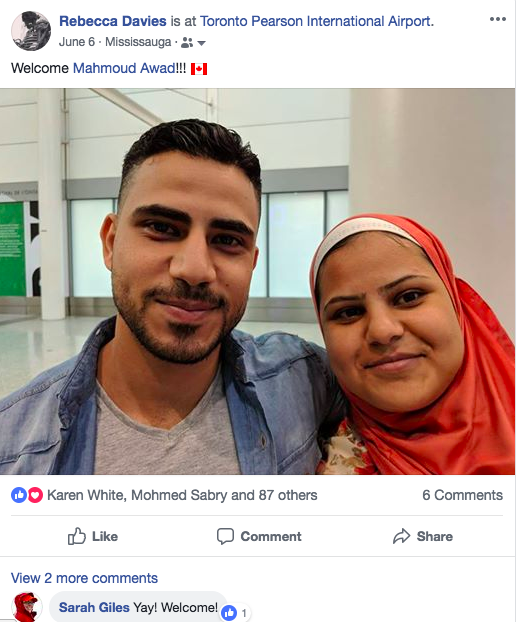
On June 6, I was there, in the international arrivals hall, with a sign. For the third time. I’d joined my friend Sawsan Awad and her family to greet her brother, Mahmoud, the latest human being sponsored by  Ripple and it was at this exact spot in Terminal 1, in December 2015, where we had first met Sawsan, her husband Mohamad, and the rest of the Abdallah family in person.

Family reunification is important for the wellbeing of newcomers, and was something that Sawsan had said she wanted and needed - to restore links with some of her family after being separated by war. And so we did not hesitate to sponsor her youngest brother, who was still stuck in Lebanon.


It can take four hours for newcomers to walk through those automatic doors, but I always want to be there, just on the other side, even before the plane lands and for the whole time it takes them to get processed. With my sign, red and white carnations, and Canadian flag. I will not miss the moment the arrivals doors open and they come through, a moment that represents joy, journey, meaning, grace, relief, grief, sadness, happiness, weariness, survival, openness, philanthropy, resistance, resilience, family, citizenry, past, present, and future. I’m unapologetic about this. Such human moments generate more humanity. It’s a ripple effect.


Two months of settling into his new life in Toronto, Mahmoud told me, “Arriving in Canada is one of the best things that ever happened to me. Because I speak English, I’ve faced nothing like the challenges faced by many newcomers. But settling in a new community takes effort. I’m working hard and trying to get involved in the community. I still miss my family and friends back in Syria and Lebanon. l had no choice but to leave. After so many years, I finally reunited with my sister and her family. She has three beautiful daughters, and the two older ones, Aya and Reemas, are very happy and excited to have another uncle around. My sister Sawsan was overwhelmed with joy, and burst into tears when she was at the airport to pick me up.”

In a couple of weeks I’ll be returning from another business trip and walking through that spot where we first met Sawsan and her family, then Amr, Rasha, and baby Kareem, the second Syrian family our group had sponsored, and now, Mahmoud. And I’ll look for more signs, think with gratitude of those who’ve arrived, and the many more we must bring through those automatic doors at arrivals.

*Government Assisted Refugees, Joint Assistance Sponsorship, Blended Visa Office-Referred

By Rebecca Davies

Wednesday, 6 June 2018

Keeping a balance between the now and my roots

Amr Al-Farham, his wife Rasha and their son Kareem arrived in Toronto in December 2016. They are the second Syrian family our group had sponsored to come to Canada. We asked Amr to give our supporters an update about how the family has settled in.  


I promised, with pleasure, that I would write a post a year after our arrival and now it’s been almost 19 months. My wife and I were, and still are, overwhelmed with life, and this is another sign of becoming Torontonians. I think that one of the most important signs of becoming a Torontonian is that what you think you can do is way less compared to what you can actually do. 

When I knew that moving to Canada is happening, my child had just gotten out of the incubator after two months of intensive care. He had been born prematurely. To celebrate both events, we threw a big party at our flat in the city of Gaziantep, which we call Aintab, in the south of Turkey. During the party, my Syrian friend who had been to Canada before gave me what sounded like a very precious advice: “Amr, you won’t believe me if I told you that the country is extremely cold. Please wrap-up very well even under your pants as many people lose their genitals due to the extreme cold. If you’re not well prepared, your genitals will fall off and you will lose them forever.” 

My friend’s advice was untrue but the cold he told me about was something I never experienced in my life. I know now where the famous Game of Thrones’ phrase “Winter is coming” comes from, and how weather here controls not only the way people dress “the crows on the wall” but also how people act, react, live, behave and even smile.


Upon arrival, most people in Toronto have been very welcoming. I later figured out that the reason was that we were the hot topic in the news. We were the topic of debate and, to a much lesser degree, a target of insult for some conservatives. Unlike many Syrian friends in the diaspora who were hiding their identity in the public fearing becoming a target of hate, discrimination or just simply getting bombarded with tons of political and religious questions, I decided to say out loud that I had recently arrived as a Syrian refugee and was open to all responses. In downtown Toronto, the responses were usually warm and welcoming.

However, I would receive the strangest comments and questions that one would not expect. Here are some examples from different people during the past 18 months:
-   "You’re Syrian! Oh wow, that’s cool! I am happy to meet one in person, are you really as traumatized as they say in the news?"
-   "Oh, welcome to Canada buddy! May I ask a question; did you really cross the sea and walk across Europe in order to make it here?"
-   "We are glad you are here and safe; do you need toasters? We have an extra one?"

In our culture we use different bread (what people call pita here is actually Syrian bread), so toasters are not essential in our diet. But my answer to the last question was: “Thank you very much, what we really need here is a job.”

Speaking English and having university degrees helped us jump many steps forward. Ripple Refugee group understood this from the very first time they met us. Instead of registering us in a language school or showing us how to take a first TTC ride, they put huge efforts into networking and helping us write our resumes and cover letters in an attractive way for a Canadian employer. I want to mention the invaluable one-on-one meetings with group member Keith, who is a HR specialist.
With all the support we received, and by being proactive, flexible and positive, by talking to everyone and sending our resumes everywhere, my wife started working in a media company in February. She has since been promoted and given a permanent contract, while I was able to get a limited contract with Doctors Without Borders as a project manager. 

Being in an advantaged position, I volunteered my language skills and translated for Syrian newcomer families who did not speak any English, which connected me with many families who were not as advantaged as we were back home. They told me how determined they were to build a new life for themselves and for their loved ones. They were eager to study, or just jump at any job opportunity and start providing for their families despite all the challenges. I was also introduced to different private sponsorship groups who were from different age groups and different professions. Some were faith based while other were just neighborhood groups, work colleagues or even dog walkers. But what they all shared is that they were amazing people who were willing to provide as much support and care as possible.

Fleeing a war-torn country is not something that is easy to overcome. We still have our parents in relatively safer cities but with mortars occasionally falling around and kidnappings. They live under a brutal, oppressive and corrupt regime in a permanent failed economy and prevailing misery in the air. We have friends and family who are scattered around the world, with similar education qualifications. Some have been successful while others are still struggling. We talk to them on the phone and many reveal how desperate and helpless they are. I believe that if my friends in Germany, Spain, France or even Turkey and Egypt were privately sponsored and provided with similar support opportunities as happened to me and my wife, they would have been doing much better now and their host countries would have been benefiting from their skills.

In my mindset now, I am not a refugee anymore. I am a newcomer with skills, a Torontonian who follows up with elections, local news and checks the TTC updates every weekend. I am writing this article while my son is running around me, mumbling short sentences of mixed English and Syrian Arabic words. I have a daily struggle of how to keep a balance between the now and the roots, the future and the past, my current Canadian dream of a diverse, fair and open society and my Syrian dream of a stable democratic and pluralist country.  

By Amr Al-Faham